More From Green Room


Key takeaways
Govtech is a $154 billion technology market with durable customers, unusually high retention and an increasingly active group of well capitalized acquirers. Now AI is creating another catalyst: incumbent platforms are focused on accelerating their AI roadmaps, and buying may prove considerably faster than building.
Govtech, short for government technology, is the software and technology that state governments, local governments, agencies and public education systems use to run their operations and serve constituents. Customers are loyal to trusted vendors and openly refer one another, creating some unusual economics for an early stage software market.
We have been investing in govtech since our first fund, starting with DebtBook, and it is now the most concentrated vertical market within the CreativeCo Capital portfolio, with seven companies. We wanted to share what we have learned about why govtech works for early stage investors, who is buying, what the risks are, and what we look for.
Govtech is a growth equity category with durable customers, high retention, and a visible exit market, and the well capitalized consolidators in that market are focused on their AI roadmaps.
The total technology spend of US state and local governments is estimated at $154 billion, according to Guggenheim's Q2 2026 govtech report. Spending has grown at a 4-5% annual rate historically, reflecting a steady adoption of tooling to support government operations, and it is forecast to reach $194 billion by 2029.
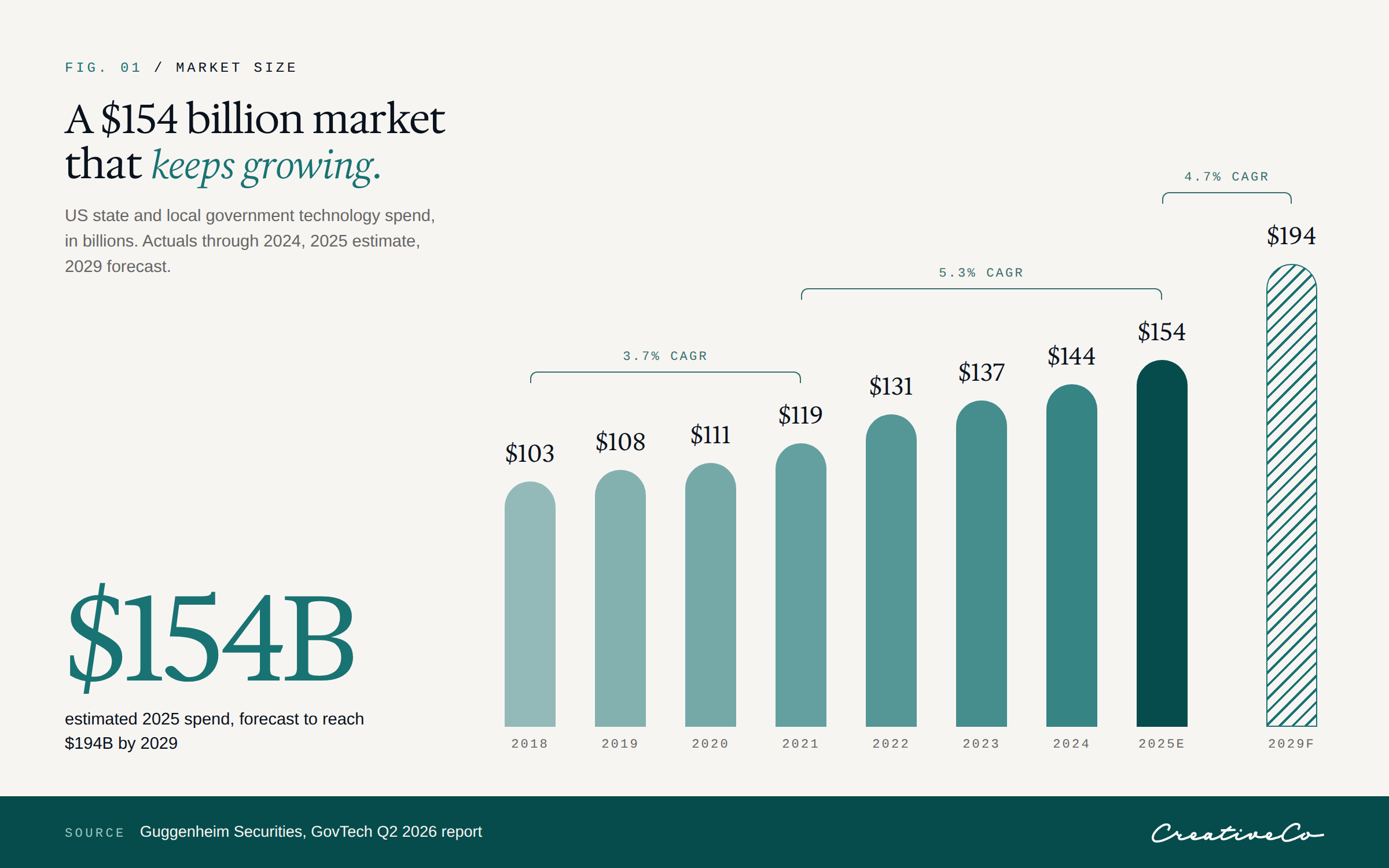
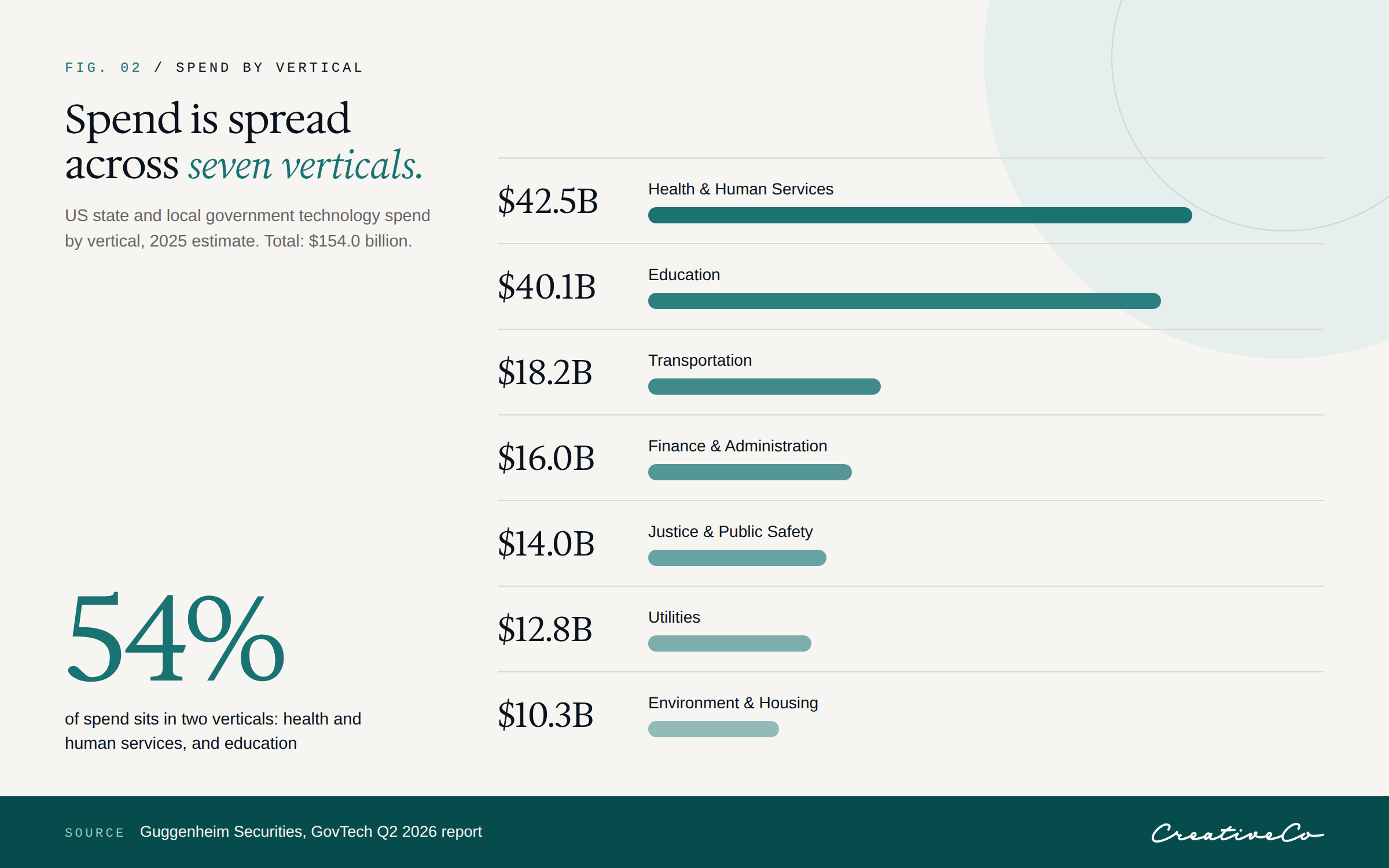
This meaningful market is comprised of a fragmented universe of specialized products across a wide spectrum of government use cases. Health and human services is $42.5 billion, education is $40.1 billion, transportation is $18.2 billion, finance and administration is $16.0 billion, and justice and public safety is $14.0 billion. More than half of all spend sits in the first two. No single vendor covers the wide surface area.
Local governments and local government agencies are the bulk of the govtech market. There are roughly 94,400 state, local and education entities in the US. By our analysis, about 41,500 of them clear a >$10k per year software budget, and about 28,000 of those are local.
The breadth of this buyer landscape is what enables the fragmentation in the solution space. Govtech startups can operate across the state, local, education and agency levels, or be very specialized in nature.
Govtech is attractive to investors for three reasons: capital efficient growth through reference-based sales, high revenue retention, and a visible exit market.
Capital efficient GTM via reference-based sales. Selling into government organizations is driven by successful case studies that are openly shared from one organization to another and discussed on the govtech conference circuit. Governments are open to sharing results, unlike enterprises, as they do not compete with one another. As a result, startups can grow quickly and efficiently in this space leveraging references, as we have seen across our portfolio.
Governments do not compete with one another. A win in one city becomes a reference in the next.
High revenue retention. While government sales cycles can be longer than in commercial software, govtech companies can demonstrate higher revenue retention rates than their commercial peers. Government entities are less likely to shop their vendors on an ongoing basis, allowing govtech startups to demonstrate gross revenue retention rates above 95%. We wrote in June about the ever-shrinking investable box, and how 90%+ GRR has become a hard line for many investors. In govtech, the retention bar is higher with 95%+ being the target. While it is still early in their customer journey, our portfolio company Madison AI for example has 100% gross revenue retention since inception.
A visible exit market. For any investment, it helps to know who the likely buyers are. In govtech, there is an identifiable set of active acquirers with capital and a track record of acquisitions.
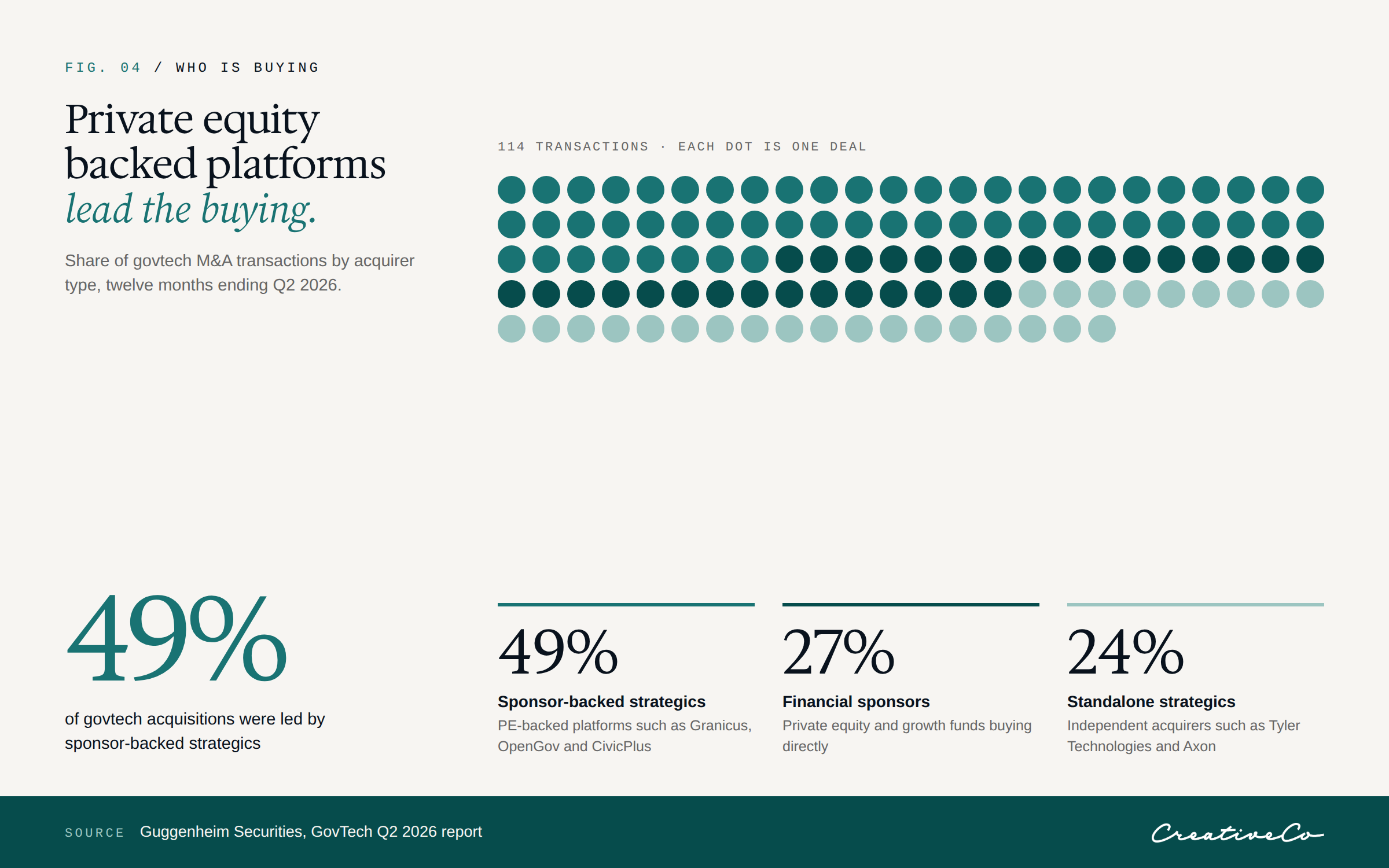
Private equity backed platforms are now the most active acquirers of govtech companies. In the last twelve months as of Q2 2026, there were 114 govtech M&A transactions. 49% of these deals were led by PE sponsor-backed strategics, 24% by standalone strategics such as Tyler Technologies, and 27% by financial sponsors. Transaction volume was up 52% year over year.
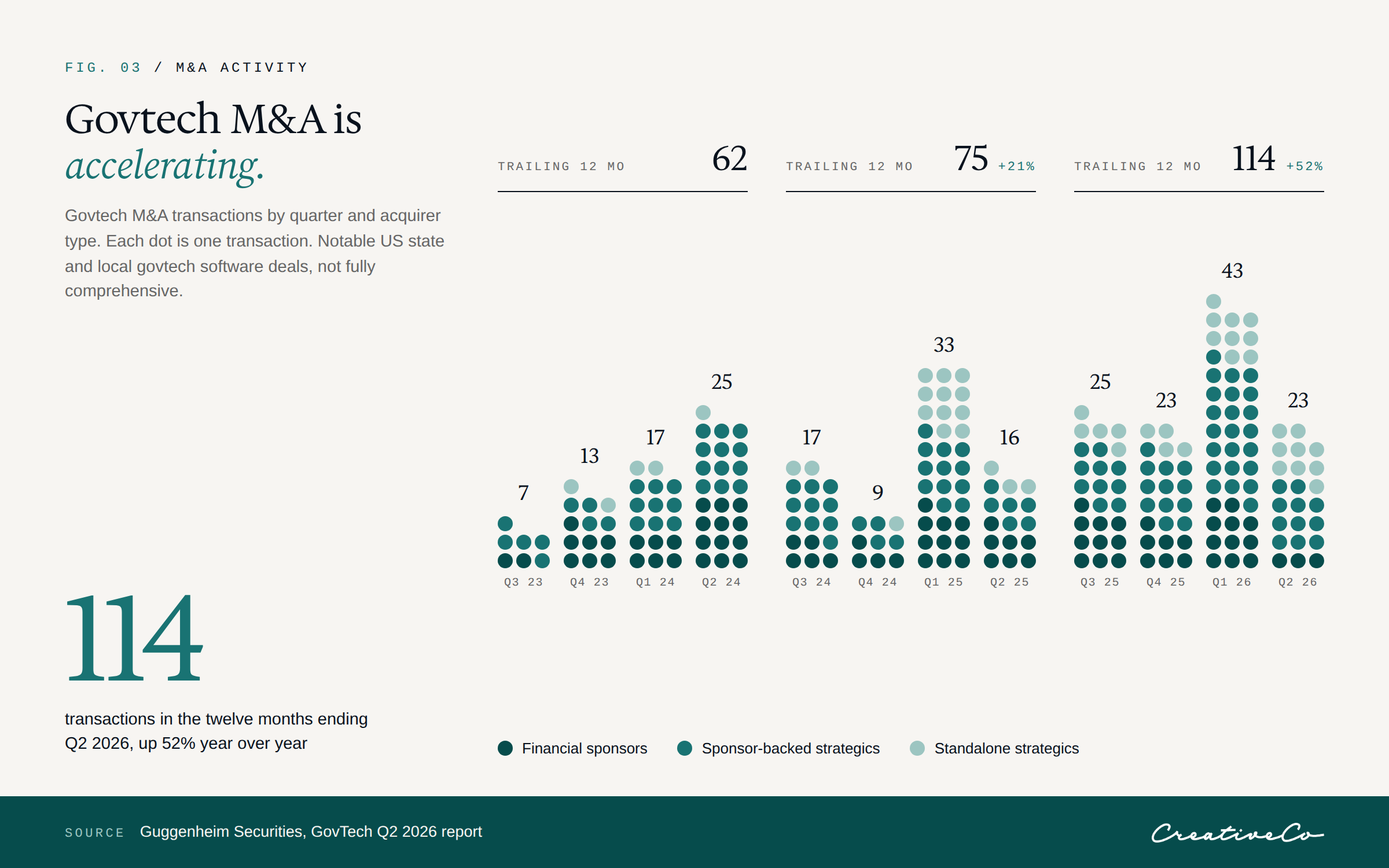
Private equity capital has created active consolidators in the market such as CivicPlus, Granicus, OpenGov, Sovra, and Govineer. Public entity Tyler Technologies has long been an active consolidator, but now private capital is driving consolidation across several buy-and-build strategies. The outcomes in this space can be meaningful. OpenGov was acquired by Cox Enterprises at a $1.8 billion valuation, and Granicus explored a sale at roughly $4 billion. Granicus has completed 16 acquisitions, and OpenGov and CivicPlus have completed eight each.
AI is adding another catalyst to an already active acquisition market. The incumbent systems of record in govtech are well capitalized, deeply embedded and difficult to displace. But they are also under pressure to demonstrate an AI roadmap. For many of them, acquiring emerging AI capabilities may be faster than building them internally.
The recent deal list makes the point. Accela acquired Civira AI. Axon acquired Prepared. CivicPlus acquired Streamline. OpenGov acquired Ignatius. Clariti acquired CivCheck. Euna acquired GrantExec.
Like most markets, the incumbent SaaS platforms are likely to face pressure from AI-native startups as well as investors pushing for AI-driven growth and differentiation.
The systems of record in this market are well capitalized and under pressure to show an AI roadmap. That is a good backdrop for an AI-native govtech startup that is gaining traction.
Sales cycles are long. Procurement is slow, and a first contract takes patience. The same inertia that slows the first sale also tends to protect the renewal. Reference-based selling and cooperative purchasing contracts can help shorten the sales that follow.
Budgets are public and political. Government spending is subject to budget cycles and changes in federal funding. In practice, state and local technology spending grew every year from 2018 through 2025, including 2020, according to Guggenheim. Much of that spend goes to software that runs day-to-day operations, such as payroll, permitting, utility billing and 911 dispatch. Governments need those functions whatever the budget climate, so that software tends to be among the last line items cut.
Each niche is competitive. Govtech is a self-contained market, but each category within it, from permitting to treasury to public safety, is competitive. Companies compete with established vendors and new entrants for the same buyers, and they have to win on product and relationship. That fragmentation is also why the consolidators exist, and a trusted company in one niche can be a valuable acquisition for them without becoming a platform itself.
Larger governments are targets of frontier labs. Incumbents and the frontier model providers are all moving, and larger governments in particular are targets for the frontier labs. We believe the durable value sits in the government-specific data layer underneath the model, which is difficult engineering work that general-purpose providers do not solve out of the box. We wrote about this in what makes software AI-native.
These are the investable box criteria, applied to government.
CreativeCo's last three govtech investments were AI-forward offerings: Madison AI, City Detect and Citibot.
Madison AI has grown ARR 3x on an LTM basis, as cities seek to embrace AI for operational efficiency. City staff often work across ten or more systems that don't talk to each other. Madison leverages an AI-native architecture to span across that legacy system of record infrastructure, providing end users with answers and workflow automations across the underlying integrated data set. This new technology and new value proposition should be strategically interesting to the well capitalized systems of record in this market.
City Detect deploys computer vision cameras and proprietary AI models on city vehicles to automatically identify city code infractions, and is launching new models to identify road conditions and other infrastructure assessments from the same deployments. It is physical AI applied to municipal work, the intelligence layer on top of vehicles a city already runs, which our partner Ashley Gautreaux wrote about in Physical AI Is Changing the Economics of Robotics.
Citibot, whose original product augments a city's 311 help center with AI chat and voice, has introduced a new offering that uses AI to automatically audit a city's website content for accuracy, freshness and accessibility compliance.
The established companies in our portfolio are moving as well. DebtBook is actively working on agentic AI solutions to expand the scope of its already competitive treasury management platform. Since day one, DebtBook has abstracted debt issuance data from its clients' debt documents so that it can be represented accurately in the software. This underlying data set is now a solid foundation for LLM-based automations and knowledge tools that help treasury staff manage their cash and debt obligations. We believe that domain-specific AI harnesses represent the next upside in vertically-focused software businesses.
In a reference-driven market, relationships are how an investor sees companies early. Each of our govtech investments has made the next one easier to find. We serve on the Madison AI board of directors with Tom Spengler, a founder of Granicus, one of the original govtech platforms. Nate Levine, one of the founders of OpenGov, is on the Madison advisory board. We collaborate closely with Rachel Stern, who runs GovTech Ventures, a pre-seed fund focused on govtech investing. CreativeCo is also a partner and sponsor of CivStart, a govtech focused early stage accelerator. We first met Erica Olsen and Madison AI at the 2024 CivStart conference in Kansas City.
The same relationships are how our companies get in front of the later stage growth equity funds and strategics that are active in this market. We expect govtech to be a key focus area for CreativeCo going forward.
Govtech is a large market with stable growth, high retention, and a growing list of well capitalized buyers that need AI. We intend to keep investing there.
What is govtech?
Govtech, or government technology, is software and technology sold to state and local governments, public agencies and public education systems to run operations such as finance, permitting, public safety, transportation and constituent services.
How big is the govtech market?
US state and local government technology spend is estimated at $154 billion, growing 4-5% annually and forecast to reach $194 billion by 2029, according to Guggenheim.
Is govtech a good market for venture and growth equity investors?
We believe so. Govtech companies benefit from reference-based sales, gross revenue retention above 95%, and an increasingly active base of strategic and private equity acquirers.
What are the risks of investing in govtech?
The main risks are long sales cycles, exposure to public budgets, competition within each niche, and competition from incumbents and frontier labs adding AI. They are offset by durable customers, high retention, and an active acquirer market.
Is govtech spending resilient in a downturn?
Historically, yes. US state and local technology spend grew every year from 2018 through 2025, including 2020, according to Guggenheim.
Who are the largest govtech acquirers?
Tyler Technologies is the long-standing public consolidator. Private equity backed platforms including Granicus, OpenGov, CivicPlus, Sovra and Govineer now lead roughly half of govtech M&A transactions.
How is AI affecting govtech M&A?
Incumbent platforms are acquiring AI-native startups to accelerate their roadmaps. Recent examples include Accela acquiring Civira AI, Axon acquiring Prepared, and OpenGov acquiring Ignatius.
Sources

.svg)


%20(1).png)